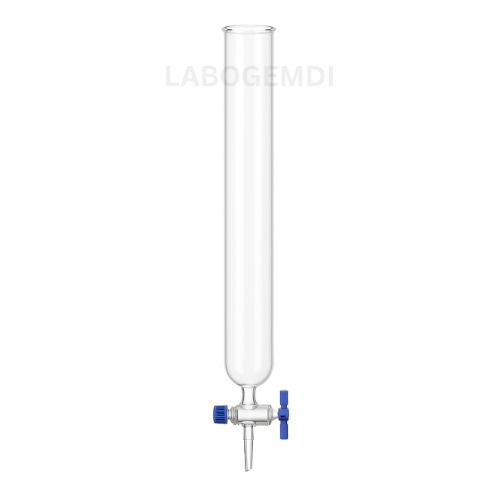
Description
Column Chromatography is a widely used separation technique in chemistry that isolates individual components from complex mixtures. It operates on the principle of differential adsorption, where components in a mixture are separated based on their varying interactions with a stationary phase (usually a solid, like silica gel or alumina) and a mobile phase (a liquid solvent or solvent mixture).
Components of Column Chromatography
-
Stationary Phase: Often silica gel (SiO₂) or alumina (Al₂O₃), packed inside the column. It acts as the adsorbent.
-
Mobile Phase (Eluent): A solvent or mixture of solvents that flows through the column, carrying the sample along.
-
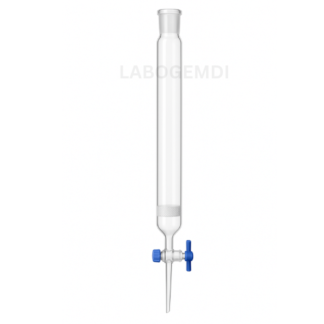
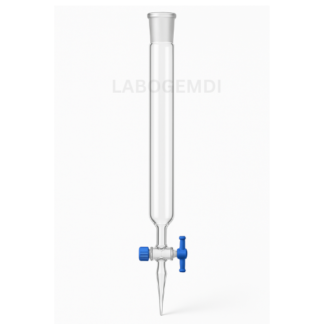
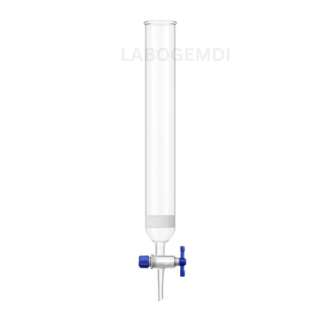
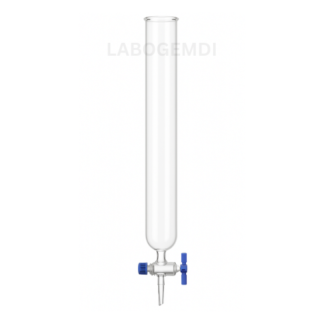
Chromatography Column: A glass or plastic cylindrical tube, typically vertically oriented.
-
Stopcock (e.g., PTFE Stopcock): A valve at the bottom of the column that controls the flow of the mobile phase. PTFE (Polytetrafluoroethylene) is chemically resistant and non-reactive, ideal for handling various solvents.
Working Principle
-
The sample is loaded at the top of the column.
-
The mobile phase is allowed to flow through the column under gravity or pressure.
-
Different compounds in the sample move at different rates based on their polarity and affinity for the stationary phase.
-
More polar compounds interact strongly with the stationary phase and elute slower, while less polar compounds elute faster.
Applications of Column Chromatography
-
Purification of Organic Compounds:
-
Used in both research and industrial laboratories for purifying reaction mixtures.
-
-
Isolation of Natural Products:
-
Extracts from plants or organisms can be fractionated to isolate active components.
-
-
Environmental Analysis:
-
Separation of pollutants from water, soil, or air extracts for further analysis.
-
-
Pharmaceuticals:
-
Purification of drug intermediates and final products.
-
-
Quality Control:
-
Ensures product purity by separating and identifying contaminants.
-
-
Preparative Chromatography:
-
Produces gram-scale or larger quantities of purified compounds.
-
Disclaimer: Product images are for illustration purposes only. The actual brand received may vary based on availability, as Labogemdi sources high-quality laboratory products from multiple trusted suppliers. While we are not directly affiliated with specific brands, we ensure that all products comply with laboratory and research-grade standards, meeting the requirements of academic institutions, research laboratories, and industrial applications.