
Description
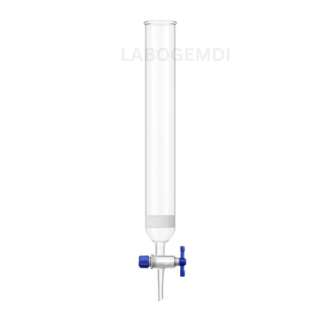
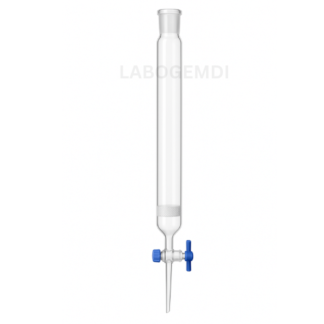
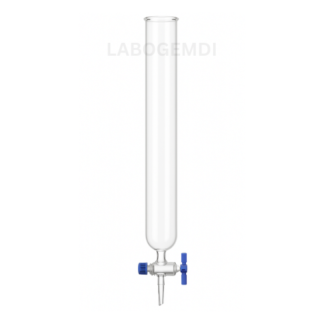
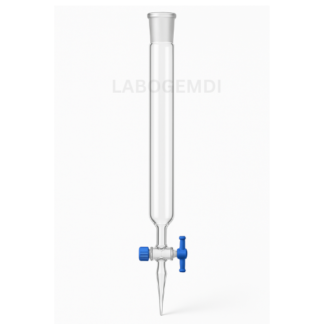
A chromatography column with PTFE stopcock and socket is a laboratory glassware used in gravity-based or low-pressure column chromatography. This design is optimized for secure, leak-free connections to other apparatus, such as a reservoir, fraction collector, or vacuum line, enhancing functionality in both preparative and analytical chromatography.
1. Key Components and Their Functions
| Component | Description |
|---|---|
| Glass Column Body | A cylindrical borosilicate tube that holds the stationary phase and sample. |
| PTFE Stopcock | A precision valve made of polytetrafluoroethylene (PTFE), chemically inert and used to regulate solvent flow. |
| Socket (Ground Glass Joint) | A standardized ground glass joint (e.g., 24/29 or 29/32) at the top of the column that allows airtight connection to other glassware, such as solvent reservoirs, funnels, or adapters. |
2. Working Principle
This chromatography setup is based on differential adsorption or partitioning between two phases:
-
Stationary Phase: A solid adsorbent (e.g., silica gel or alumina) packed into the column.
-
Mobile Phase: A solvent or solvent mixture that flows through the column, carrying the sample mixture.
Steps:
-
Packing: The stationary phase is added as a slurry or dry-packed into the column.
-
Connection: The socket is used to connect a reservoir or funnel containing the mobile phase.
-
Sample Loading: The sample is applied to the top of the stationary phase.
-
Elution: The mobile phase is introduced and controlled via the PTFE stopcock.
-
Fraction Collection: Separated components are eluted and collected based on their migration rates.
3. Function of the Socket
| Feature | Benefit |
|---|---|
| Glass Socket (Ground Joint) | – Enables leak-proof connection to solvent reservoirs or vacuum lines – Allows pressurized elution or continuous solvent feed – Enhances modularity with glass adapters, funnels, or drying tubes – Prevents solvent evaporation or contamination during separation |
4. Advantages of this Design
| Component | Function |
|---|---|
| PTFE Stopcock | – Chemically inert – Allows precise control of solvent flow – Prevents leaks and degradation from solvent exposure |
| Glass Socket | – Ensures secure, standardized connections – Can be fitted with stoppers, septa, or adapters for closed systems |
5. Applications
Organic Synthesis & Purification
-
Isolation of desired products and removal of side products or unreacted starting materials.
Phytochemistry & Natural Product Research
-
Fractionation of plant or microbial extracts.
Environmental Chemistry
-
Extraction and separation of pollutants or biomarkers from environmental samples.
Pharmaceutical Quality Control
-
Purity profiling and separation of drug components.
Preparative Chromatography
-
Gram-scale purifications in academic and industrial laboratories.
Disclaimer: Product images are for illustration purposes only. The actual brand received may vary based on availability, as Labogemdi sources high-quality laboratory products from multiple trusted suppliers. While we are not directly affiliated with specific brands, we ensure that all products comply with laboratory and research-grade standards, meeting the requirements of academic institutions, research laboratories, and industrial applications.