Description
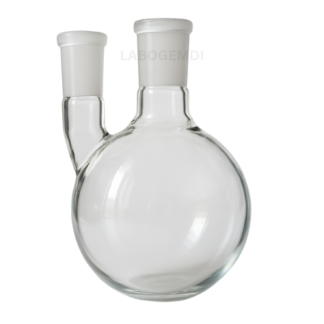
Two-Neck Round-Bottom Flask are commonly used in reactions that require two separate connections. One neck might be used for a condenser, and the other could be used for adding reagents or evacuating gases. For example, during a distillation, one neck might hold the distillation head, while the other might allow for an inert gas to flow into the flask.
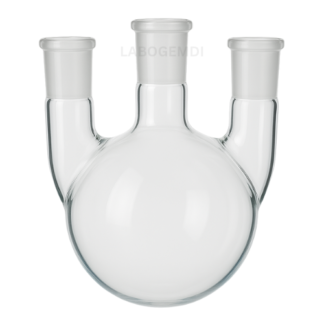
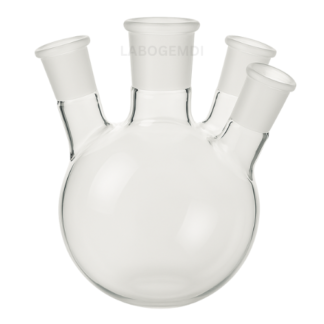
Purpose and Uses of Parallel Side Necks
- Symmetry and Equal Distribution
- Simultaneous Connections
- Better for High-Volume or High-Throughput Applications
- Enhanced Stability and Access
- Flexibility in Experiment Design
Typical Applications
- Simultaneous Reagent Addition: In processes requiring the addition of multiple reagents or gases simultaneously, parallel side necks allow for efficient, organized connections.
- Multistep or Complex Reactions: For reactions with multiple phases, such as multi-stage distillation or extraction processes, the parallel necks help manage the flow and addition of substances without compromising the setup.
- Reactions Requiring Multiple Monitoring Devices: Parallel side necks are particularly useful when you need to monitor or control several aspects of a reaction at once, such as using a thermometer, condenser, and gas inlet all at the same time.
Disclaimer: Product images are for illustration purposes only. The actual brand received may vary based on availability, as Labogemdi sources high-quality laboratory products from multiple trusted suppliers. While we are not directly affiliated with specific brands, we ensure that all products comply with laboratory and research-grade standards, meeting the requirements of academic institutions, research laboratories, and industrial applications.