Description
| GRADE EQUIVALENCE | |||||
|---|---|---|---|---|---|
| Particle retention in liquids (µm) | CHMLAB | WHATMAN | S&S | M&N | SARTORIUS |
| 1.6 | GF1 | GF-A | GF 50 | GF1 | MGA |
| 1 | GF2 | GF-B | GF 51 | GF2 | MGB |
| 1.2 | GF3 | GF-C | GF 52 | GF3 | MCG |
| 2.7 | GF4 | GF-D | GF 53 | GF4 | MGD |
| 0.7 | GF5 | GF-F | GF 55 | GF5 | MGF |
| 1.5 | GF6 | 934-AH | GF 30 | GF6 | 550-HA |
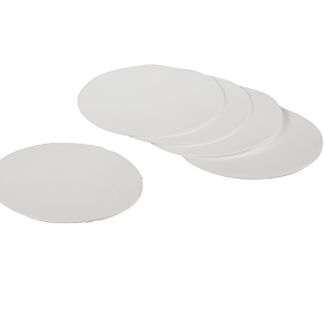
Borosilicate glass microfiber filters are specialized filtration media composed of ultra-fine borosilicate glass fibers. They are widely used for liquid and air filtration due to their high temperature resistance, chemical inertness, and excellent retention of fine particles.
1. Key Properties
- High Filtration Efficiency: Can capture particles as small as 0.3 microns.
- Low Resistance to Flow: Provides fast flow rates with minimal pressure drop.
- Thermal Stability: Can withstand temperatures up to 500°C (depending on thickness and binder type).
- Chemical Resistance: Resistant to acids, bases, and organic solvents, making them suitable for harsh environments.
- High Adsorption Capacity: Effective for retaining fine particulate matter, aerosols, and some dissolved impurities.
- Binder-Free: Ensures purity for analytical applications.
2. Applications
Environmental Analysis
- Air Monitoring: Used in PM (particulate matter) sampling for environmental pollution studies.
- Water Testing: Filtration of suspended solids in water and wastewater analysis.
Laboratory and Analytical Applications
- Gravimetric Analysis: Used for total suspended solids (TSS) measurements.
- Microbiological Filtration: Prefiltration of biological samples in microbiology and biotechnology labs.
Industrial Applications
- Pharmaceutical Filtration: Removal of particulates from solutions in drug manufacturing.
- Food and Beverage Industry: Used for quality control in liquid filtration processes.
Air and Gas Filtration
- HVAC Systems: Employed in air purification systems to remove airborne contaminants.
- Stack Emission Testing: Used to monitor industrial emissions.
| Parameter | Quartz Microfiber Filters | Glass Microfiber Filters |
|---|---|---|
| Composition | 100% quartz microfibers (pure silicon dioxide, SiO₂) | Borosilicate glass microfibers (with or without resin binders) |
| Binder Content | Binder-free | Available in binder-free or binder-containing variants |
| Thermal Resistance | Up to ~1000 °C | Up to ~500 °C (binder-free); lower with binders |
| Chemical Resistance | Excellent; inert to most chemicals including acids and bases | Good; resistant to acids and solvents except HF and strong bases |
| Background Contamination | Extremely low (ideal for trace metal and carbon analysis) | Low, but may contain trace contaminants (higher with binders) |
| Filtration Efficiency | High, especially for fine particulate matter | High for particles ≥0.3 µm |
| Typical Applications | Air sampling (PM, OC/EC), dioxin/furan collection, combustion studies | Water/air particulate analysis, total suspended solids, pre-filtration, gravimetric analysis |
| Pre-treatment Requirement | Often pre-heated (e.g., 500–900 °C) to eliminate contaminants | May be pre-ashed (e.g., 450–500 °C) for gravimetric accuracy |
| Weight Stability | Excellent stability for gravimetric analysis | Good stability, but may be affected by binder presence |
| Mechanical Strength | Moderate; more fragile due to lack of binder | Higher (especially with resin binders) |
| Preferred for Carbon Analysis? | Yes (OC/EC and thermal-optical methods) | No (higher background carbon possible) |
| Preferred for Water Filtration? | No (not hydrophilic by default) | Yes (especially for suspended solids and biological debris) |
Disclaimer: Product images are for illustration purposes only. The actual brand received may vary based on availability, as Labogemdi sources high-quality laboratory products from multiple trusted suppliers. While we are not directly affiliated with specific brands, we ensure that all products comply with laboratory and research-grade standards, meeting the requirements of academic institutions, research laboratories, and industrial applications.