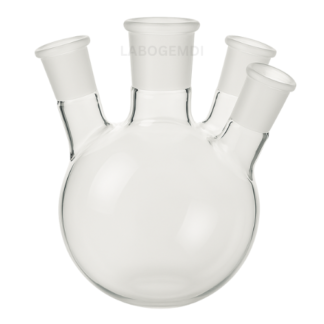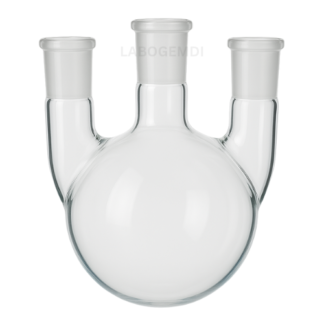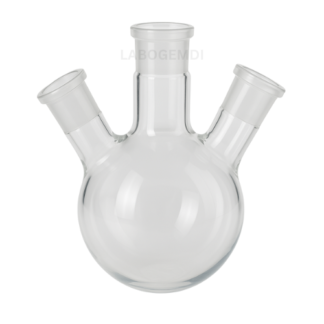
Description
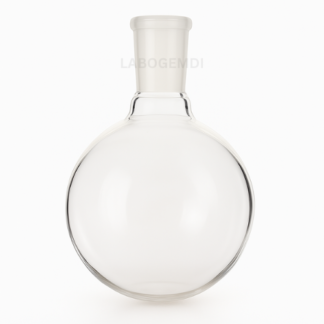
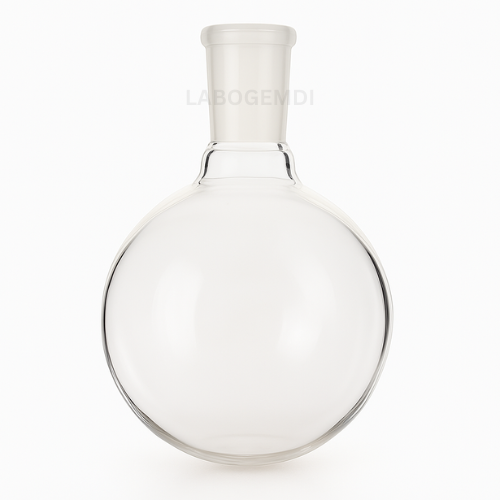
A single-neck round-bottom flask is one of the most commonly used pieces of glassware in laboratories, especially in chemistry and chemical engineering. The round-bottom shape facilitates uniform heating, while the single neck provides one connection point for various apparatus.
Purposes
-
Heating and Reactions: The round-bottom design allows for efficient heating due to the even distribution of heat across the curved surface. It is ideal for reactions that require consistent or elevated temperatures.
-
Distillation: It is widely used in distillation processes where the flask can hold liquid that is heated and vaporized.
-
Evaporation: Used for evaporating solvents or other liquids under controlled conditions, often in combination with a condenser.
-
Synthesis: The flask serves as a container for chemical reactions that involve reagents, particularly in organic synthesis.
-
Solvent Addition or Withdrawal: It can be used for the addition or removal of solvents and other liquids via a dropper or burette connected to the neck.
Typical Applications of a Single-Neck Round-Bottom Flask
-
Organic Chemistry:
-
Used in many standard organic reactions that require heating, such as refluxing, condensation, or hydrolysis.
-
Frequently used in distillation setups for separating solvents, extracting essential oils, or purifying liquids.
-
-
Refluxing:
-
The flask is often paired with a condenser for reflux reactions, where the liquid is heated to the boiling point, then condensed and returned to the flask to continue the reaction process.
-
-
Distillation:
-
A key tool in simple or fractional distillation to purify liquids by separating components based on their boiling points.
-
-
Synthesis of Chemicals:
-
Often used in the synthesis of organic compounds where controlled heating and the introduction of reagents are required, such as in esterification or grignard reactions.
-
-
Evaporation:
-
The flask can be used for the evaporation of solvents in a rotary evaporator setup, where the solvent is gently heated under reduced pressure to prevent decomposition of sensitive materials.
-
-
Vacuum Filtration:
-
It is sometimes used in vacuum filtration setups to hold the liquid being filtered under a vacuum to accelerate the process and increase purity.
-
-
Solvent Recovery:
-
In industrial settings, it is used in solvent recovery systems, where it holds liquid waste or solvents that need to be distilled or evaporated for recycling.
-
Disclaimer: Product images are for illustration purposes only. The actual brand received may vary based on availability, as Labogemdi sources high-quality laboratory products from multiple trusted suppliers. While we are not directly affiliated with specific brands, we ensure that all products comply with laboratory and research-grade standards, meeting the requirements of academic institutions, research laboratories, and industrial applications.